Earnings week: Banks lead off
Big banks, ASML, and BlackRock report July 14-15
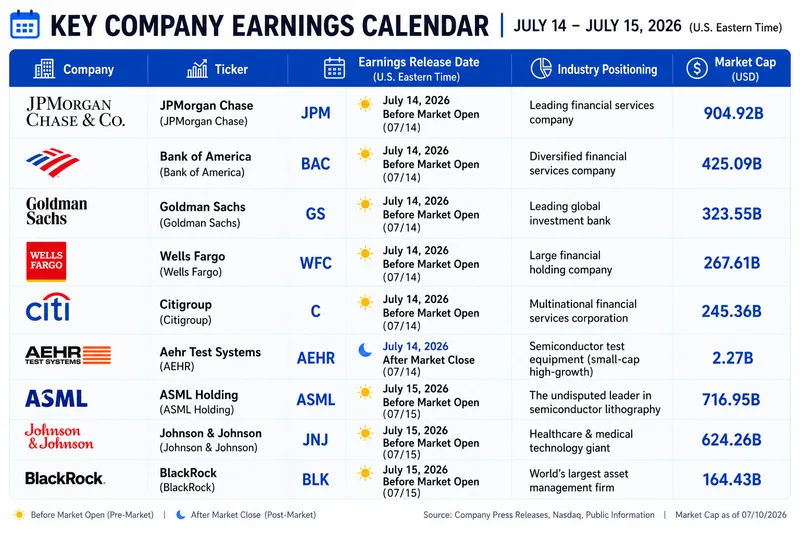
Q2 earnings season is officially open, and July 14-15 brings a heavy slate: five of the biggest US banks, global lithography leader ASML, asset-management giant BlackRock, healthcare heavyweight Johnson & Johnson, and semiconductor-equipment maker Aehr. Wall Street's financial giants take the stage together next week, followed by the chokepoint of the chip supply chain and an evergreen name in healthcare.
ASML (ASML)
The undisputed king of semiconductor lithography, and the one truly irreplaceable layer underneath the relentless expansion of top-tier AI compute hardware.
Earnings date: July 15
Outlook: Overweight
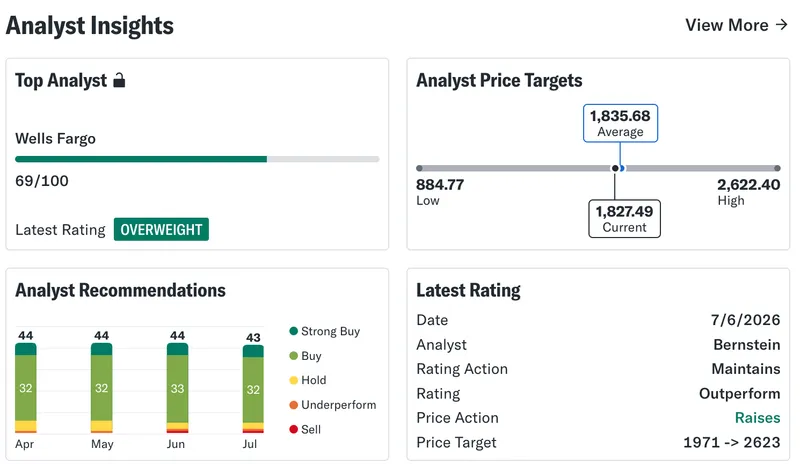
Analyst view: Wells Fargo's Joe Quatrochi team recently lifted its ASML price target sharply from $1,750 to $2,200, keeping an Overweight rating. Wells Fargo and Credit Suisse argue that the recent sector pullback, driven by swings in memory-chip maker margins, actually hands ASML a strong catch-up opportunity, and Wells Fargo raised its 2027 global wafer fab equipment (WFE) market forecast from $180 billion to $190 billion. ASML holds its strong 2026 guidance of €36 billion to €40 billion in net sales.
Key focus: EUV order visibility as TSMC, Intel, and other advanced-node fabs ramp AI-chip capacity; and whether the Low-NA roadmap stays on track, with a target of at least 60 systems delivered in 2026 and at least 80 in 2027.
Now to the six core financial names.
JPMorgan (JPM)
The undisputed leader in global asset management and retail banking, with deep diversification, real resilience, and the most to gain from the current recovery in US capital markets.
Earnings date: July 14
Outlook: Moderate buy
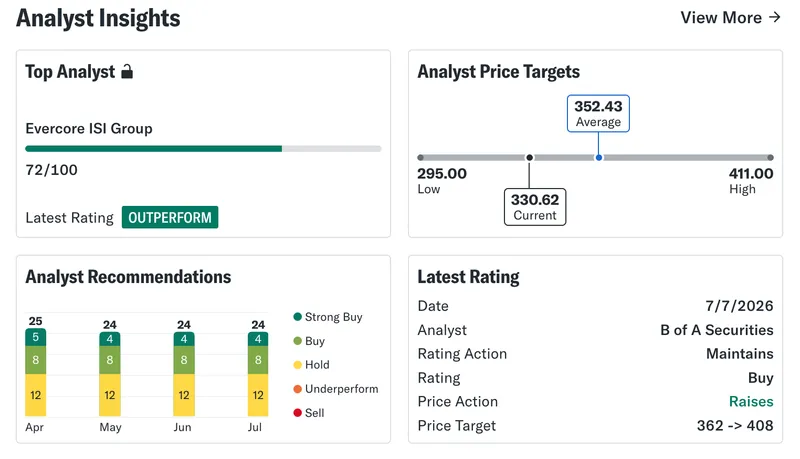
Analyst view: Wall Street's consensus is a Moderate Buy. Across the 20-plus analysts covering the stock, the average 12-month price target has risen to around $352.00 (with a high of $411.00), a sign that even near record highs, the giants expect the strong to keep getting stronger. The market is pricing in about 3.5% implied volatility on July 14 report day. J.P. Morgan Private Bank's Q2 2026 review calls US corporate earnings growth robust and broad-based, with margins still expanding, especially at tech and diversified banks riding AI capex, and the overall outlook highly constructive.
Bank of America (BAC)
The bank with the most stable US retail base, now proving its all-around strength through explosive growth in trading.
Earnings date: July 14
Outlook: Bullish
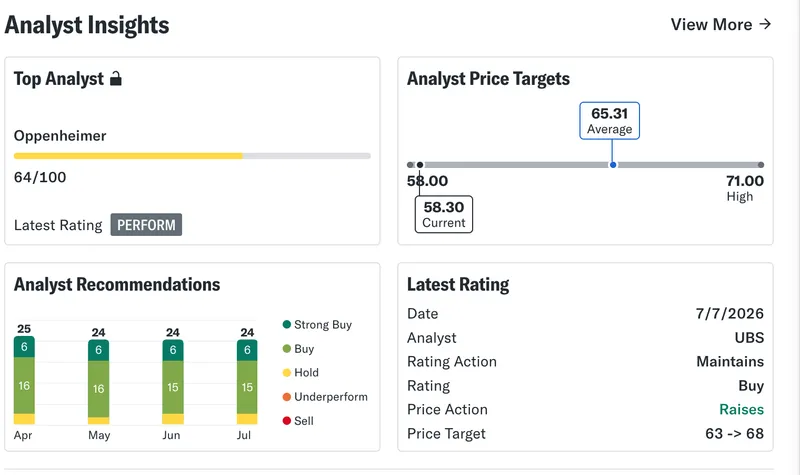
Analyst view: Per a recent Reuters briefing, Bank of America expects Q2 2026 trading revenue to rise about 15% year over year, well above the market's earlier modest estimates, driven by surging client demand across FICC (fixed income, currencies, and commodities) and equities. Zacks now projects BAC's quarterly EPS at $1.11 on revenue of $30.26 billion, implying strong year-over-year growth of 24.7% and 14.4%.
Key focus: Whether trading revenue really tops 15% growth as Reuters reports, and beats JPMorgan and Goldman; and whether credit quality holds, with consumer card and loan loss provisions staying healthy under current economic strain.
Goldman Sachs (GS)
Wall Street's purest wealth machine and the king of investment banking, a deep beneficiary of the record global M&A and AI-financing boom of the first half of 2026.
Earnings date: July 14
Outlook: Bullish
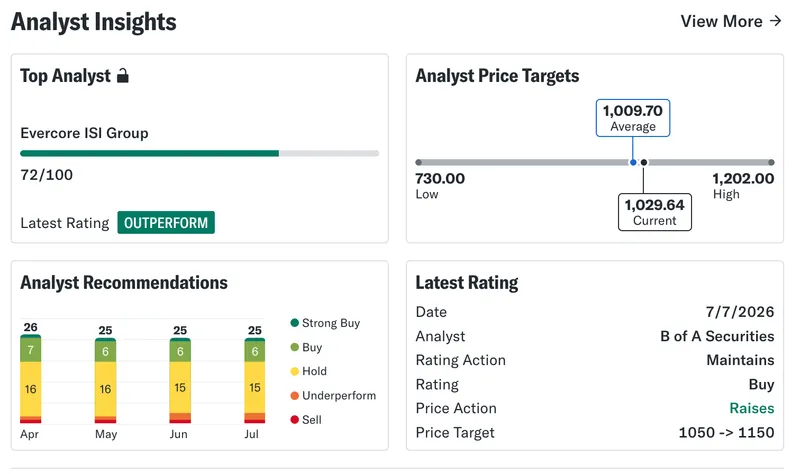
Analyst view: FactSet-compiled data puts Goldman's quarterly revenue estimate at $16.13 billion to $16.22 billion, with EPS seen high, at $13.95 to $14.31. Wells Fargo's Mike Mayo holds the Street's highest target at $1,195, and Morgan Stanley lifted its target to $1,099. Word is Goldman's equities trading desk could top $5 billion in revenue again this quarter, helped by unusually active AI-driven hedge fund activity in Asia, while its M&A advisory work in the first half of 2026 approached a record $1 trillion.
Wells Fargo (WFC)
A retail giant stepping out of the shadow of the Fed's asset cap and onto offense, now a favorite of Wall Street's top institutions thanks to a generous payout plan.
Earnings date: July 14
Outlook: Bullish
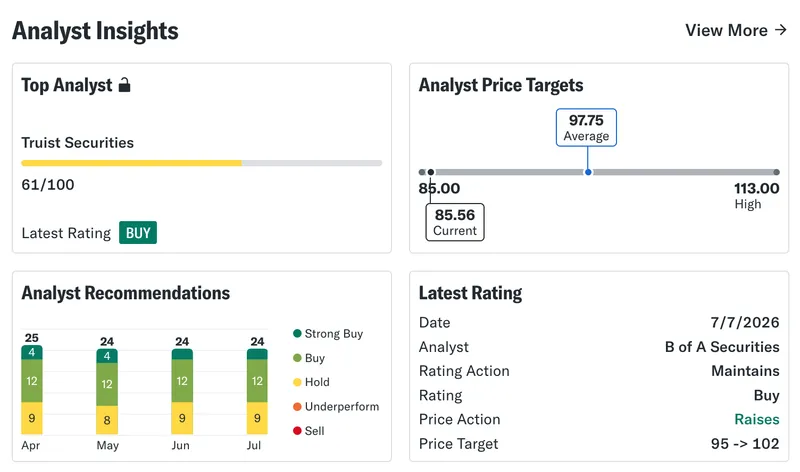
Analyst view: Goldman Sachs recently added Wells Fargo to its US Conviction List, citing an aggressive growth transformation as the asset cap is expected to lift. JPMorgan put it on a "90-day positive catalyst watch" ahead of earnings, and UBS named it a high-conviction, high-return pick with a $104 target. Wells Fargo passed the Fed's 2026 stress test, raised its quarterly dividend 11% to $0.50 a share, and reaffirmed its full-year net interest income (NII) target of $50 billion.
Citigroup (C)
A global financial giant deep in the middle of a strategic overhaul, moving toward a re-rating on AI-driven cost cuts and a $30 billion buyback.
Earnings date: July 15
Outlook: Mixed
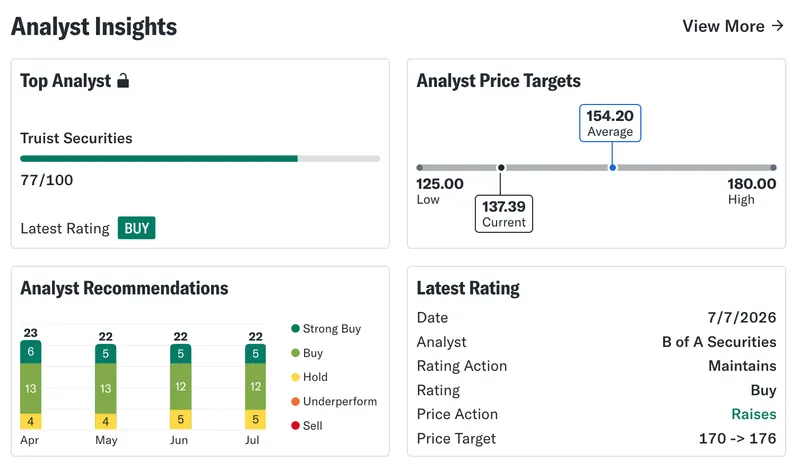
Analyst view: Citi's quarterly EPS estimate is $2.67. Per a Trefis report, CFO Gonzalo Luchetti gave upbeat Q2 guidance, expecting quarterly trading revenue growth in the high-single to low-double digits year over year, far above the roughly 2% analysts had penciled in. Confidence in the turnaround is building as the wealth unit's return on capital employed (RoCE) rebounded from negative in 2023 to nearly 11% last quarter.
BlackRock (BLK)
The definitive bellwether of global asset management, riding both a staggering flow of assets and the opportunity in AI's physical supply-chain and private credit.
Earnings date: July 15
Outlook: Overweight
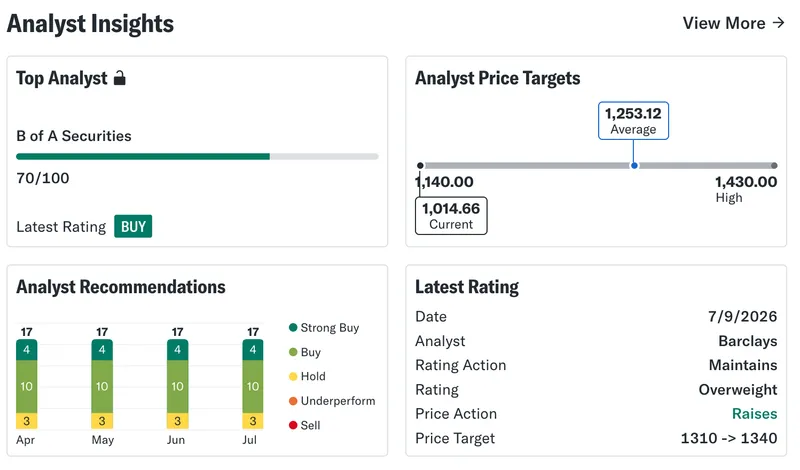
Analyst view: Wall Street's two top investment banks lined up behind BLK: Morgan Stanley set the Street's highest target at $1,430 (Overweight), and Goldman Sachs raised its target to $1,313. In its 2026 midyear outlook, BlackRock Investment Institute's global chief investment strategist Wei Li stressed that the AI supercycle is only beginning, with the market racing for scarce resources like power, grids, chips, and data centers. BlackRock is riding that macro trend, drawing heavy inflows through broad positions in public and private credit and infrastructure funds.
Key focus: Whether total AUM sets another record, and how fast retail and institutional money flows into infrastructure funds and ETFs; and how much private credit is now contributing to profit against traditional bank lending.
As JPMorgan put it in its midyear report: "Volatility is never the enemy; unmanaged risk is." From July 14, these nine giants spanning finance, compute infrastructure, and healthcare report in turn. In a fast-rotating summer 2026 market, watching their forward guidance closely is how you stay in step with the next leg of the AI and heavy-asset bull run.