Tech | Apple buying CXMT
Hot stock, real orders? The market says 41% for 2026
CXMT surged 466% on its debut, briefly topping Tencent in market cap intraday.
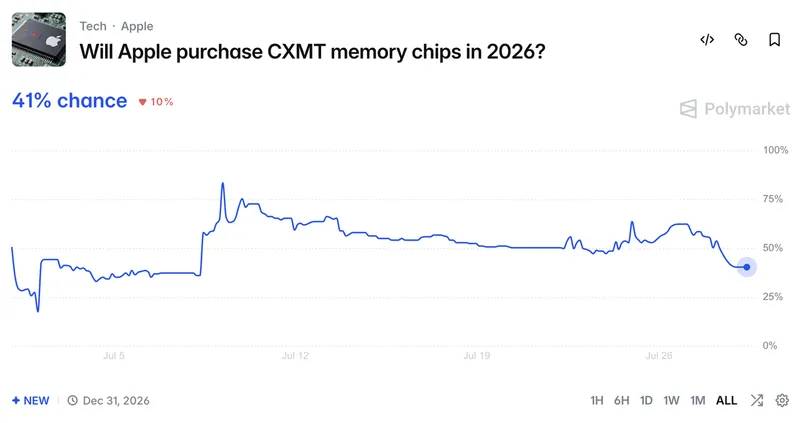
But in prediction markets, traders are staying cautious on whether it can land an Apple order. The "Will Apple purchase CXMT memory chips in 2026?" market currently sits at 41%, down about 10% recently.
Apple starts testing – will it become an order?
CXMT rose 466% on day one, closing at 49 RMB, with intraday market cap briefly passing Tencent. The IPO raised at least $8.5 billion and drew 212x oversubscription.
More important than the stock price: Apple has begun testing CXMT DRAM chips for devices sold in the China market – direct grounds for the "will buy" case.
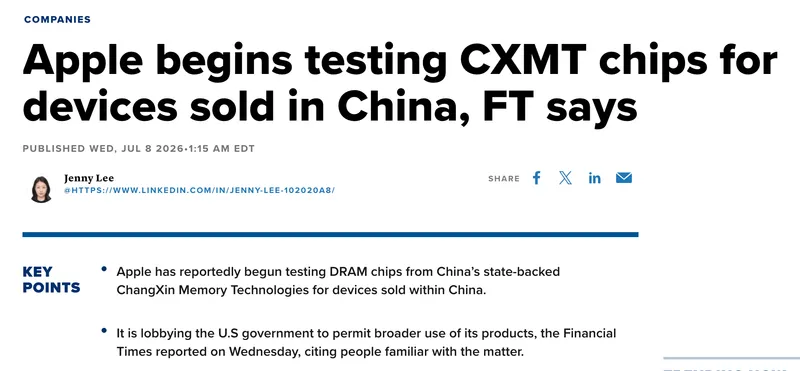
But testing isn't a formal order. What actually pushes the probability up would be certification passing, a purchase agreement, or real installation records.
What could push the odds higher
Apple genuinely needs more memory supply options. The AI boom is squeezing global capacity and driving up procurement costs for consumer electronics makers. Bringing in CXMT would help Apple reduce its dependence on Samsung, SK Hynix, and Micron, and strengthen its bargaining power.
Apple CEO Tim Cook told The Wall Street Journal that all options should be on the table and that the company should study every supply source. He didn't name CXMT directly, but the stance was notably open.

Apple is also lobbying the Trump administration for permission to expand its use of CXMT chips. If an exemption is granted – or product certification and supply agreements follow – the 41% probability could rise further.
Three hurdles still stand
The market holds the probability at a cautious 41% because an order has to clear three hurdles.
1. US regulation: CXMT has been placed on the US Defense Department's Section 1260H list, which cites direct or indirect ties to China's MIIT and SASAC. The list isn't an outright trade ban, but it raises the political and compliance pressure Apple faces in procurement. If the government denies an exemption, the "will buy" odds could fall.

2. Micron and US chip industry pushback: Micron has warned that allowing Apple to use Chinese-made memory in markets outside the US could hit domestic US memory demand. That signals Apple's lobbying is meeting resistance from the American chip industry. If Micron gains more political support, the market could shift further toward "no."

3. Apple's supply chain certification: Apple's requirements for yield, quality, output, and supply stability are extremely high. Even if the government clears the way, CXMT still needs to complete product testing and supply chain validation. An exemption is only the first step – stable delivery is what makes a company a formal supplier.
What signals to watch
Traders should watch three things next: whether the US government approves an exemption, whether CXMT passes Apple's supply chain certification, and whether a formal purchase or actual installation record emerges.
CXMT's IPO proved capital markets will pay up for its growth story. But prediction markets are waiting for something else: a verifiable Apple order.