Korea #7 among global markets as AI surges
Samsung and SK Hynix in the lead for memory chips
According to recent data from Bloomberg, South Korea has overtaken Canada to become the world’s seventh-largest stock market.
Behind that jump is one powerful theme: memory chips.
What used to be a cyclical business is now becoming core infrastructure for AI – and two companies are leading the move: Samsung Electronics and SK Hynix.
The KOSPI breakthrough
South Korean equities have been on a remarkable run in 2026:
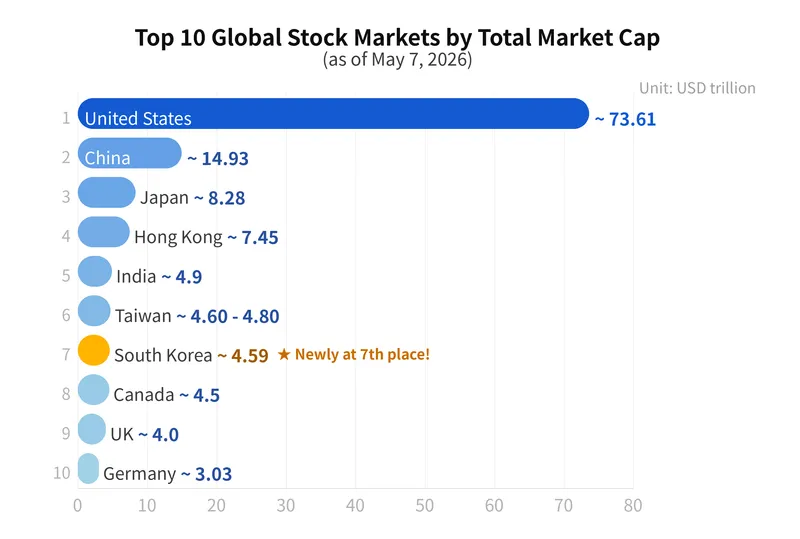
Total market value has climbed to $4.59 trillion, up 71% this year, putting South Korea ahead of Canada.
The KOSPI index broke through 7,000 on May 6, surging over 6% in a single session to close at 7,384.56 – a roughly 75% gain year-to-date and the largest annual move since 1999.
Behind all of this: Samsung Electronics and SK Hynix, and the global AI infrastructure buildout that has turned memory chips into strategic assets.
Why Samsung and SK Hynix are leading
Samsung Electronics: The full-stack AI contractor
Samsung's strength is vertical integration: chips, manufacturing, and end-device AI solutions under one roof.
Semiconductors (DS Division): Samsung's profit engine. Beyond traditional DRAM and NAND flash, it is pushing hard on HBM4 (6th-generation high-bandwidth memory) while maintaining dominant share in DDR5.
Foundry: One of only two manufacturers globally capable of producing at 3nm and below at scale, with its GAA (gate-all-around) architecture giving it a meaningful energy efficiency edge for AI chip customers.
On May 6, Samsung's stock surged more than 14% in a single session, pushing its market cap above $1 trillion for the first time. Q1 operating profit hit 57.2 trillion KRW – more than 8 times the year-ago figure – triggering a wave of foreign buying into a stock that had been deeply undervalued.
SK Hynix: The AI memory specialist
SK Hynix runs a different playbook: extreme specialization in the highest-value memory products the AI era demands.
HBM dominance: SK Hynix sets the benchmark for HBM3E (5th generation) and was first to deliver 12-layer stacked products at scale. It holds more than 50% of the global HBM market and is Nvidia's primary memory partner. Q1 2026 operating margin reached 72%.
Long-term supply agreements: SK Hynix has locked in a multi-year, multi-billion-dollar DDR5 supply agreement with Microsoft and is advancing a five-year general DRAM agreement with Google. Market consensus expects SK Hynix to be the exclusive memory supplier for NVIDIA's next-generation Vera Rubin platform.
Why memory is the defining trade of this AI cycle
Three structural forces are driving this and none of them are reversing soon.
1. HBM capacity is sold out: SK Hynix and other leading manufacturers have zero remaining 2026 HBM capacity. As NVIDIA's data center footprint expands exponentially, high bandwidth memory has become the single most constrained component in the AI supply chain.
2. Big tech is locking in supply: Tech giants are signing long-term agreements to secure supply, locking in pricing power for years rather than quarters.
3. Supply is getting tighter across the board: As wafer capacity shifts toward HBM3E and server-grade LPDDR, supply of standard DRAM and NAND is also tightening. Korean investment banks project this supply-demand imbalance to persist beyond 2027.
Samsung and SK Hynix have made the transition from cyclical component suppliers to strategic AI infrastructure. As long as the AI model arms race continues, the memory supercycle has room to run. Trade Samsung and SK Hynix using USDC directly from Bitget Wallet.