Japan, Korea hit records as chip stocks surge
Samsung and SK Hynix at all-time highs on HBM demand
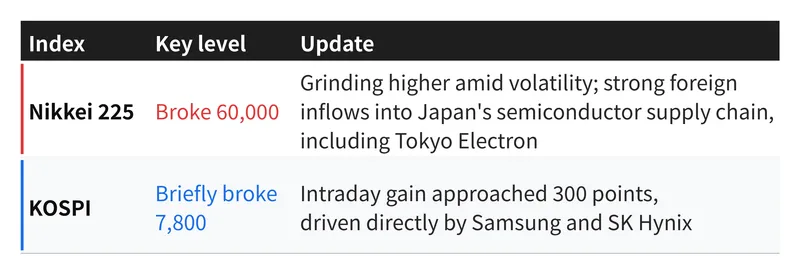
May 11 was a historic day for Asian markets. The Nikkei 225 held above 63,000 points. Korea's KOSPI surged nearly 4%. The force behind this move Samsung and SK Hynix, who are leading a wave of AI hardware repricing that's pulling capital into Asia at speed.
Index performance
Chip stocks dragged both benchmark indices through key psychological levels in a single session.
Meet the two chip giants
SK Hynix and Samsung Electronics: Both manufacturers of HBM (high-bandwidth memory), a product in short supply with surging demand.
SK Hynix
SK Hynix leads the global HBM market and the market is repricing that leadership fast.
Stock price up more than 11% in a single session
~52.6 trillion KRW in Q1 revenue
DRAM average selling prices up ~60% in Q1; NAND up ~70%
Some brokerages have raised their price targets to 2.7 million KRW
Samsung Electronics
Samsung is firmly in the HBM3E supply chain and moving into mass production for leading AI chips.
Stock price up more than 6% in a single session, hitting an all-time high
Net profit came in well above consensus despite revenue missing slightly – a strong signal of margin recovery
Why Japan and Korea are moving together
There are three forces are driving this synchronised rally.
1. AI server demand shifting from quantity to performance
As AI models scale, the requirement isn't just more memory – it's faster, higher-value memory. HBM sits at that intersection, and both Samsung and SK Hynix are the only suppliers that matter.
2. The Japan-Korea semiconductor alliance
Japan controls upstream inputs: photoresists, wafer materials, and advanced semiconductor equipment. Korea controls downstream: memory chip fabrication. The Nikkei's new high is the market's repricing of how much profit flows to this alliance in the AI era.
3. Capital rotating into Asia
With inflation pressure easing globally and compute demand still running hot, Japan and Korea offer a rare combination – high AI exposure at reasonable valuations. That's attracting both defensive and offensive capital flows at the same time.
A word of caution: A gap-up of this size often comes with elevated sentiment, and short-term profit-taking from these levels is a real risk. As equity markets absorb capital, JPY and KRW volatility will also affect the reported earnings of multinationals – worth watching closely as the rally continues.