Inside the stablecoin wars
When issuing dollars no longer pays, who holds dollar power?
For years, stablecoins looked like one of the most profitable businesses in finance. The issuer takes your dollars, buys US Treasuries, earns the interest, and usually keeps it, while you, the holder, see none of the yield. But as competition heats up, the real value is shifting away from issuing a stablecoin toward distributing it and owning the payment network behind it.
Three models are now taking shape.
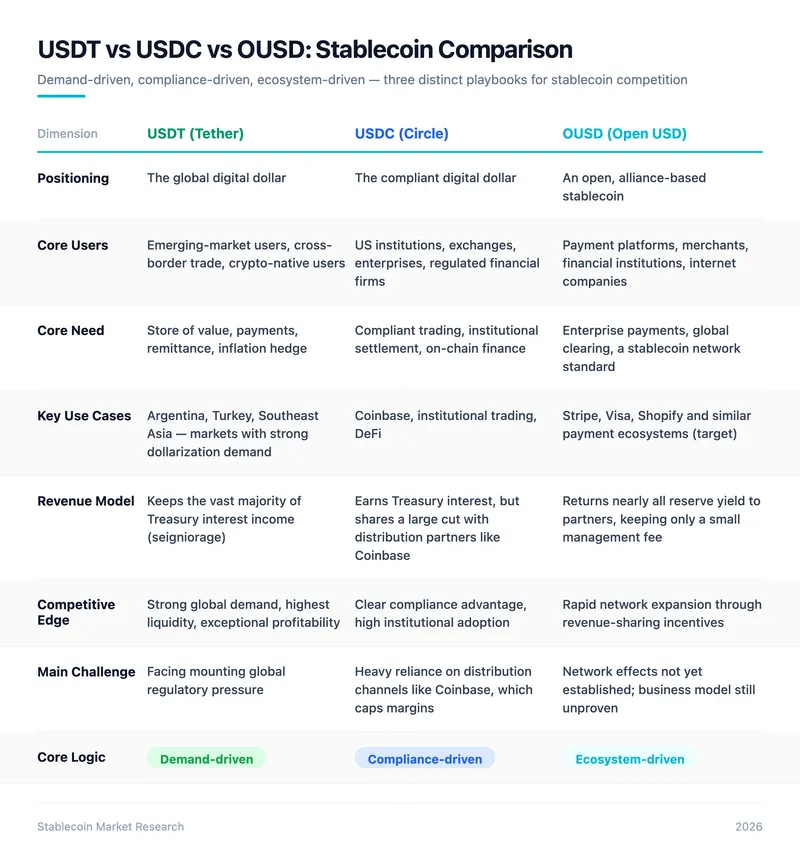
USDT is the global digital dollar model. It mostly serves emerging markets, and in places like Argentina, Turkey, and Southeast Asia it behaves more like digital cash: a way to store value, send money across borders, and pay for everyday things. Because that demand is real and spread across the world, Tether doesn't lean on any single distribution channel. It keeps most of the reserve yield for itself and has built enormous earning power on top of it.
USDC is the compliant, institutional model. Backed by the US regulatory system and the institutional market, it has become one of the most important regulated stablecoins in the world. But it leans heavily on platforms like Coinbase to reach users. For every dollar Circle earns in revenue, more than half goes to Coinbase. Issuing the coin matters, but what really decides the profit is the platform that owns the user.
Open USD (OUSD), just launched, offers a third path: the open alliance model. It brings together more than 140 institutions, including Visa, Mastercard, Stripe, Shopify, and Coinbase, and returns almost all of the reserve yield to its partners. The idea is to give payment platforms, merchants, and financial institutions a reason to promote it together, turning OUSD into the underlying standard for the next generation of payment and settlement, rather than a coin that profits from issuance alone.
Three bets on the same dollar
Each model is really a different bet on where the competition is headed. USDT runs on global demand. USDC runs on a compliant ecosystem. OUSD runs on an open network.
Who connects the dollars
As onchain dollars keep multiplying, the thing that matters most may no longer be who issues a stablecoin. It may be who can connect the different stablecoins, blockchains, and payment networks, so you never have to think about whether you're holding USDT, USDC, or OUSD. You just pay, transfer, and settle as if it were all one dollar. When that happens, the wallet and the account layer could become the most important entry point in the next global financial system.