Bitcoin Rally 2025: Why Investors Are Shifting from Gold to Crypto

Bitcoin rally has drawn worldwide focus as the top crypto asset hit a record peak beyond $124,000 during October 2025. Gold led 2025 gains at 54%, yet the Bitcoin vs gold rally balance changed sharply when funds from institutions started moving into digital holdings.
This crypto market rally shows strong money flows into spot ETFs listed in the US, which pulled in $3.24 billion in a single week. Over 114,000 BTC left major trading platforms in two weeks, showing growing institutional trust. This tight supply paired with ETF buying has driven Bitcoin to new price zones.
Economic instability fuels this Bitcoin rally as investors protect wealth from rising prices and weak currency values. Changes in interest rates and rising public debt increase demand for limited digital stores of value. Bitget Wallet enables secure stablecoin storage and seamless multi-chain trading for investors navigating this historic shift.
Key Takeaways
- The Bitcoin rally began through institutional anticipation and spot ETF approval in January 2024, creating unprecedented pre-halving demand. Bitcoin reached $73,000 before the April halving, contradicting historical patterns where peaks emerged 12 to 18 months after supply reductions.
- Gold dominated 2025 with 54% returns through September, outperforming Bitcoin's 22% gain. The rotation theory gained credibility in October when gold dropped 5.7% while Bitcoin gained momentum. Historical correlation shows Bitcoin typically lags gold by approximately 100 days.
- The Bitcoin price rally faces three critical resistance levels at $126,100, $135,000, and $140,000. Institutional hedging mechanics create complex dynamics at these zones. Breaking $126,100 opens potential toward $135,000, while $140,000 holds over $2 billion in option open interest.
Why Did the Bitcoin Rally Start in 2025?
Bitcoin rally in 2025 broke from traditional patterns through multiple converging forces.
-
Early-Cycle Timing:
The Bitcoin rally began before the April 2024 halving event, contradicting historical patterns where peaks typically emerge 12-18 months after supply reductions.
-
Institutional Capital Flows:
The bitcoin institutional rally transformed market structure as corporate treasuries acquired Bitcoin at nearly double the rate of newly mined supply throughout 2025.
-
Record ETF Demand:
The Bitcoin ETF rally brought $3.24 billion in weekly fund flows during early October, generating constant buying pressure that took up coins faster than miners could create them.
-
Supply Constraints:
Bitcoin exchange balances dropped to 2.83 million BTC in October 2025, the lowest level since June 2019, as 114,000 BTC exited centralized platforms within two weeks.
These structural factors combined with powerful macroeconomic forces. The Bitcoin macro rally gained momentum as inflation concerns and Federal Reserve rate cut expectations positioned Bitcoin as an alternative store of value. The U.S. unemployment rate reached 4.2% while the private sector lost over 36,000 jobs in September.
Market participants priced in 96% odds of a rate cut at the October 2025 FOMC meeting. Bitcoin's correlation with global liquidity stands at 83%, while its link to the S&P 500 weakened to 0.4, signaling decoupling from traditional equity markets.

Source: Finshots
How Is the Bitcoin Rally Different from Previous Cycles?
The 2025 bitcoin rally marks a fundamental shift from retail speculation to institutional strategy. The below table highlights the key differences between this Bitcoin rally and previous rallies.
| Characteristic | 2017 Rally | 2021 Rally | 2025 Rally |
| Primary Drivers | Retail FOMO, ICO mania, media hype | DeFi boom, NFT mania, early institutional entry | Spot ETF inflows, institutional capital, macro factors |
| Dominant Participants | Retail investors (90%+) | Mixed (60% retail, 40% institutions) | Institutions dominant (60%+) |
| Volatility Pattern | Extreme spikes and crashes | High volatility with sector rotation | Lower volatility, sustained trends |
| Peak Timing | 520 days post-halving | 548 days post-halving | Pre-halving ATH achieved |
| Largest Correction | 84% drawdown | 77% drawdown | 26% largest correction |
| ETF Infrastructure | None available | Futures ETFs only | Spot ETFs with $127B+ AUM |
| Corporate Adoption | Virtually none | Emerging (10-20 companies) | Widespread (172+ companies) |
How Has the Halving Timeline Shifted in 2025?
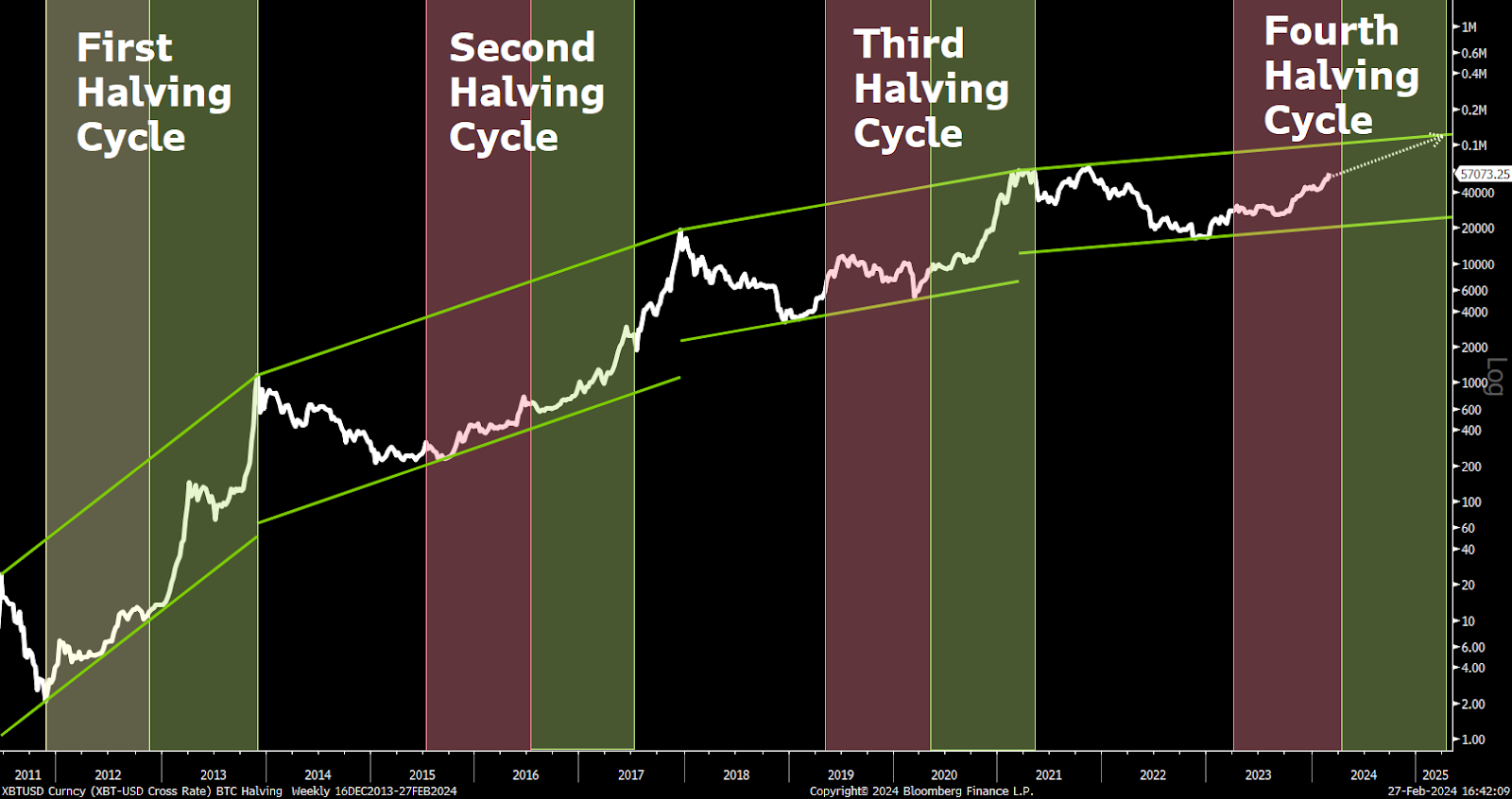
This Bitcoin rally began earlier than any previous cycle through institutional anticipation and supply shock front-running. Bitcoin reached a new Bitcoin all-time high 2025 of $73,000 in March 2024, one month before the April halving event.
This early peak altered cycle length expectations, with the Bitcoin rally now exhibiting prolonged consolidation phases rather than parabolic moves. Institutional participation has created shock absorbers that reduce extreme volatility patterns in earlier cycles.
Source: BitIRA
What Role Do Institutions and ETFs Play in the Bitcoin Rally?
Institutional infrastructure and spot ETF adoption now drive structural demand in the Bitcoin rally.
-
Spot ETF Adoption:
The Bitcoin ETF rally delivered $3.24 billion in weekly inflows during early October 2025, the second-largest weekly total since the ETF inception in January 2024.
-
Pension Fund Access:
Capital from pension funds now flows directly into BTC through ETF vehicles, enabling institutional allocators to embed Bitcoin in alternative portfolios with typical allocations of 2-5%.
-
Corporate Treasury Strategy:
By Q3 2025, 172 public companies held over 1 million BTC on balance sheets, collectively controlling 4.87% of circulating supply valued at $117 billion.
These mechanisms created what analysts describe as a turbocharge effect, with the Bitcoin ETF rally generating structural demand independent of price movements. This Bitcoin institutional rally effectively removed 18% of circulating supply from active trading by mid-2025, establishing structural scarcity.
How Has Market Psychology Evolved from Speculation to Strategy?
Previous cycles relied on emotion-driven trading while 2025 demonstrates data-driven strategic allocation through institutional frameworks.
| Behavioral Shift | Details |
| Tweet-driven volatility to macro movements | Bitcoin now responds primarily to Federal Reserve policy, inflation data, and employment reports rather than social media sentiment. |
| Retail FOMO to institutional models | Family offices apply systematic risk models with 2-5% crypto allocations using dollar-cost averaging rather than chasing momentum-driven bubbles. |
| Sudden breakouts to consolidation | Bitcoin consolidated in $100,000-$115,000 ranges throughout summer 2025, reflecting institutional accumulation strategies rather than speculative vertical price action. |
| Meme narratives to quantitative analysis | Institutions evaluate Bitcoin through multi-factor models incorporating Federal Reserve policy, on-chain metrics, and technical indicators rather than ideological narratives. |
Why Is This Rally More Macro-Dependent Than Previous Cycles?
Bitcoin's correlation with traditional macroeconomic factors has intensified as the Bitcoin macro rally now operates through Federal Reserve policy, inflation dynamics, and currency concerns. Bitcoin's link with the Nasdaq 100 hit 0.87 in 2024, while its correlation with worldwide money flow sits at 83%.
The Bitcoin vs gold rally reflects changing safe haven narratives during global tensions, with gold jumping 60% in 2025. The BTC/XAU link hit 0.85 in late 2025, showing rising institutional trust in both as paired protections against currency debasement.
Source: Coin Central
Bitcoin Rally vs Gold Rally: Is the Great Rotation Real?
The gold to Bitcoin rotation theory gained traction in October 2025 as capital flows began shifting between these competing hard assets.
| Metric | Gold | Bitcoin | Analysis |
| Year-to-Date Return (Jan-Sep) | +54% | +22% | Gold dominated through Q3 2025 |
| October 2025 Reversal | -5.7% | ||
| (single day) | +0.51% to +2% | Capital rotation signal detected | |
| Average Daily Volatility | ~15.4% | ~24.6% | Bitcoin exhibits higher volatility |
| Market Capitalization | ~$17 trillion | ~$2.1 trillion | Gold market 8× larger |
| ETF Assets (Oct 2025) | $110B+ | $127B+ | Bitcoin ETFs surpassed gold |
Despite gold's strong performance through September 2025, the Bitcoin vs gold rally dynamic reversed sharply in October. Gold dropped 5.7% on October 21 while Bitcoin gained momentum. Historical correlation patterns show Bitcoin typically lags gold by approximately 100 days.
The crypto market rally Bitcoin high reflects flight to hard assets driven by fiat currency debasement concerns. Central banks accumulated $17.3 billion worth of gold monthly during 2025. Younger investors aged 24 to 45 show 73% preference for Bitcoin.
Read more: Gold vs Bitcoin: Which Is the Better Investment in 2025 and Beyond?
Why Are Investors Moving from Gold to Bitcoin?
The Bitcoin rally attracts money from gold via economic factors, enhanced institutional systems, and demographic preferences.
-
Macro Debasement Concerns:
Central banks keep growing fiat currency supply while global tensions rise, making both gold and Bitcoin protections against monetary expansion and inflation.
-
ETF Infrastructure Accessibility:
Spot Bitcoin ETF approval in January 2024 democratized institutional access, with Bitcoin ETF assets reaching $127 billion by October 2025, surpassing gold ETF holdings of $110 billion.
-
Demographic Preference Shifts:
Younger investors aged 25 to 34 constitute 34% of crypto owners, viewing Bitcoin as digital gold with exponential upside potential that physical gold cannot match.

Source: CryptoDNES
What Key Price Levels Could Define the Bitcoin Rally?
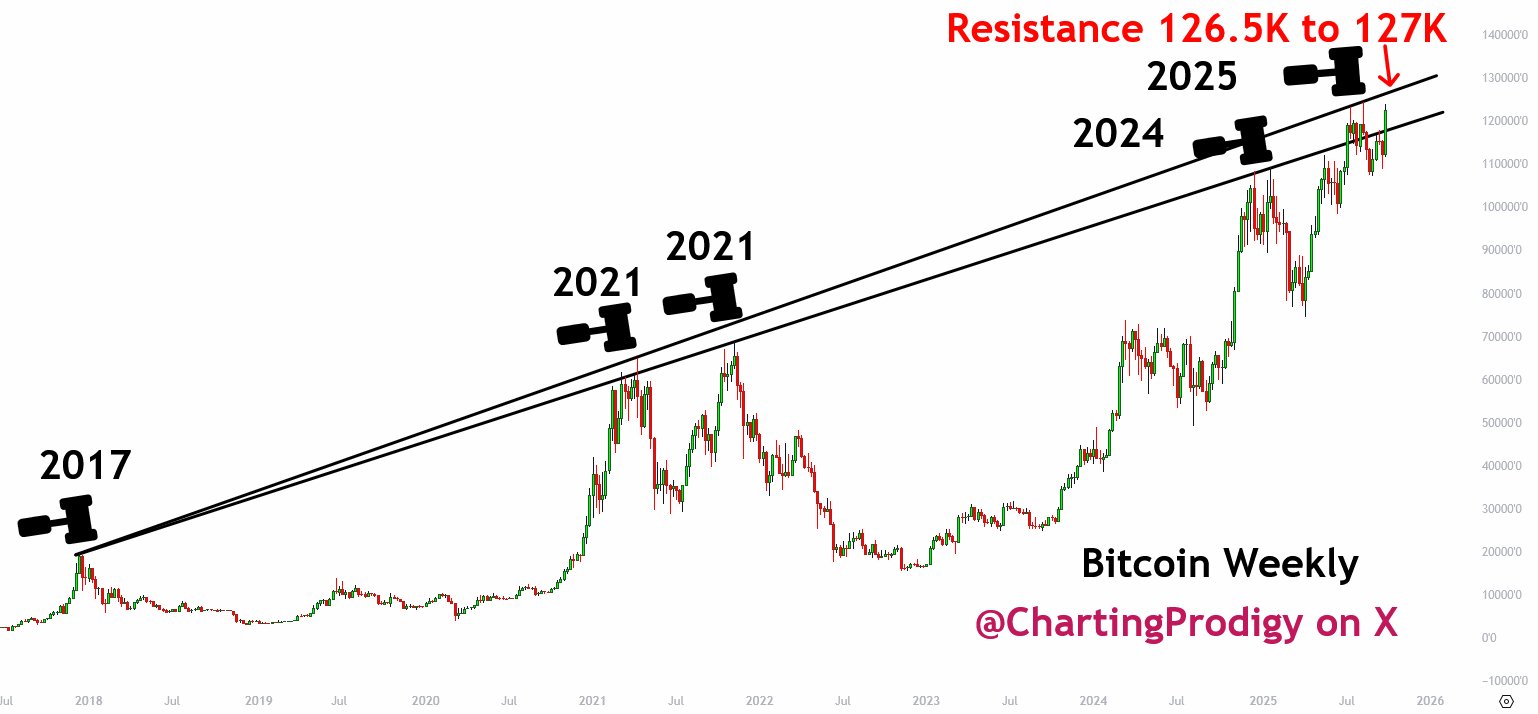
The Bitcoin price rally faces three critical resistance levels at $126,100, $135,000, and $140,000. Bitcoin traded around $124,080 in late October 2025 after reaching $125,700. The first resistance at $126,100 marks a broadening range pattern developing since mid-July.
Historical patterns reveal important differences between traditional post-halving surges and the current early-cycle dynamics.
-
Traditional Post-Halving Pattern:
Bitcoin historically reached all-time highs 12 to 18 months after halvings, with peaks occurring at 365 days (2012), 520 days (2016), and 548 days (2020) post-halving.
-
2025 Early-Cycle Rally:
Bitcoin achieved a new Bitcoin all-time high in 2025 of $73,000 in March 2024, one month before the April halving event, driven by institutional anticipation and spot ETF approval.
Resistance and support levels function through institutional hedging mechanics. At $140,000, over $2 billion in call option open interest creates price magnetism and resistance. The Bitcoin hundred thousand rally stalls when institutional hedging flows pressure prices as the Bitcoin price rally approaches these zones.
Source: @ChartingProdigy on X
Is the Bitcoin Rally Sustainable in the Long Term?
The Bitcoin rally sustainability depends on volatility patterns, institutional infrastructure, and macroeconomic conditions that shape long-term price trajectories.
-
Volatility Normalization:
Bitcoin's yearly volatility dropped 75% versus earlier periods, hitting 35.5% in 2024, showing market growth from institutional backing that reduces sharp movements.
-
Institutional Infrastructure Maturity:
Spot Bitcoin ETF assets reached $127 billion by October 2025, creating structural demand independent of price movements as 73% of supply now sits with long-term holders.
-
Macro Dependency Risks:
Bitcoin's correlation with global liquidity stands at 83%, positioning it as a liquidity-sensitive instrument whose sustainability requires continued Federal Reserve accommodative policy through 2026.
KEY INSIGHT: Corrections of 20 to 30% are normal even in bull runs, with historical data showing average Bitcoin pullbacks of 27% during upward trends before resuming momentum.
What Is Behind the Bitcoin Rally’s Psychology?
What is behind Bitcoin rally psychology involves sentiment cycles moving through FOMO, greed, and disbelief phases. The Fear & Greed Index reading of 72 to 75 in October 2025 signals strong greed. Social signals amplify dynamics through meme coin surges, Reddit activity increasing 5 to 10 times normal levels, and mainstream media coverage returning.
Institutional risk management explains why the Bitcoin rally occurs despite euphoric signals by creating stability amid retail excess. The Bitcoin rally exhibits lower volatility at 2.1% daily compared to 5.3% in 2017, reflecting dampening effects that establish a shift from retail-driven bubbles to institutional-stabilized cycles.
How Can Investors Join the Bitcoin Rally Safely with Bitget Wallet?
The following section provides practical guidance on trading Bitcoin on-chain during volatile market conditions using this application.
How to Trade Bitcoin On-Chain During the Rally Using Bitget Wallet?
On-chain trading matters during volatile conditions because centralized exchanges may face withdrawal delays or liquidity crunches. Experienced traders can participate in the Bitcoin rally with Bitget Wallet to access on-chain opportunities without relying on centralized intermediaries.
Bitget Wallet functions as a non-custodial platform enabling investors to trade Bitcoin directly on blockchain networks. The application supports multi-chain functionality for diverse trading strategies.
-
Cross-Chain Swap Access:
Use Bitget Swap to execute Bitcoin and wrapped BTC trades across Ethereum, BNB Chain, Base, and Polygon networks.
-
Stablecoin Yield Strategy:
After taking profits, utilize Stablecoin Earn Plus to hedge positions in stablecoins at up to 10% APY.
-
Optimized Execution Routing:
Access cross-chain routing technology for best price execution during volatile market conditions with automated slippage protection.
-
Payment Integration:
Spend Bitcoin or stablecoins globally via the Bitget Wallet Crypto Card for real-world transaction utility.
To trade directly on-chain and manage Bitcoin positions, investors can connect with Bitget Wallet for cross-chain swaps, stablecoin yields, and portfolio control during the Bitcoin rally.
Read more: How to Buy Bitcoin (BTC) on Bitget Wallet?
Conclusion
The Bitcoin rally in 2025 marks a fundamental shift driven by spot ETF inflows reaching $127 billion, institutional rotation from gold, and macroeconomic conditions favoring hard assets. Federal Reserve rate cuts and currency debasement concerns position Bitcoin as an alternative store of value.
The asset's digital scarcity offers advantages over traditional gold through 24/7 liquidity and borderless accessibility. Long-term holders now control 73% of supply, establishing stability that supports sustained appreciation rather than boom-bust cycles characteristic of earlier periods.
As the Bitcoin rally unfolds, investors can manage positions securely with Bitget Wallet for seamless stablecoin storage, memecoin trading, and multi-chain access across major networks.
Sign up Bitget Wallet now - grab your $2 bonus!
FAQs
1. Why did Bitcoin rally in 2025?
Bitcoin rally in 2025 stemmed from spot Bitcoin ETF inflows reaching $3.24 billion weekly, institutional adoption by 172 companies holding over 1 million BTC, and macroeconomic factors including Federal Reserve rate cuts and dollar weakness driving safe haven demand.
2. When will the next Bitcoin rally start?
When the Bitcoin rally will continue depends on breaking the $126,100 resistance level. The current Bitcoin rally remains active with potential targets of $135,000 to $150,000 by Q4 2025 or Q1 2026, subject to macroeconomic conditions and sustained ETF inflows.
3. Is the Bitcoin rally sustainable?
Whether the Bitcoin rally is sustainable depends on continued institutional support and favorable macroeconomic conditions. Structural demand from $127 billion in Bitcoin ETFs and reduced volatility at 2.1% daily create stability, though sustainability requires continued Federal Reserve accommodative policy and consistent institutional inflows.
4. How can I buy Bitcoin during the rally with Bitget Wallet?
Participating in what is behind bitcoin rally involves using non-custodial wallets like Bitget Wallet for direct custody. Download the application, create a wallet, fund via fiat or crypto transfer, and execute trades through Bitget Swap for cross-chain Bitcoin access.
Risk Disclosure
Please be aware that cryptocurrency trading involves high market risk. Bitget Wallet is not responsible for any trading losses incurred. Always perform your own research and trade responsibly.


 Banks Holding Bitcoin Japan - What the FSA’s New Rules Mean2025-10-28 | 5 mins