


From TACO to NACHO: How the Strait of Hormuz crisis is rewriting crypto's macro pricing logic
Announcement
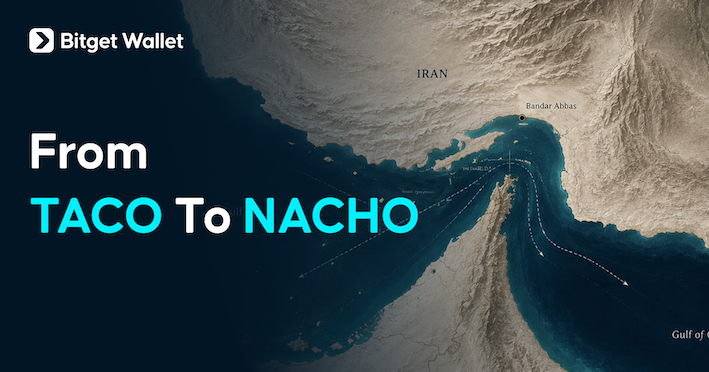
A few months ago, Wall Street was still trading an acronym with a touch of irony:
TACO, short for
Trump Always Chickens Out. It captured how markets had learned to read Trump's policy playbook. An extreme threat would be issued, risk assets would sell off, and then – as market pressure, negotiation room, or political cost rose – the tone would soften and prices would rebound. For traders, TACO wasn't a belief in the policy itself. It was a bet that maximum pressure would eventually be walked back.
In Q2 2026, that keyword began to change. A new acronym started circulating on trading desks:
NACHO –
Not A Chance Hormuz Opens. In market terms, traders are beginning to price in a scenario where the Strait of Hormuz has little chance of reopening in the near term. The phrase was pushed into broader circulation by Bloomberg Opinion columnist Javier Blas, who quoted the line: "We thought we were getting a TACO. But so far we are getting a NACHO." Nobel Prize-winning economist Paul Krugman then amplified the concept in his Substack essay
The Logic of NACHO, making the central point that unlike tariffs, the Hormuz crisis cannot be reversed by a statement, a meeting, or a social media post. Restoring normal passage requires military de-escalation, shipping normalization, insurance repricing, energy inventory buffers, and a minimum level of trust among all parties.
That is the fundamental difference between the two. TACO trades on political retreat. NACHO faces a physical bottleneck and a trust gap that are far harder to reverse quickly. For crypto markets, this is not a distant energy story. Oil prices, inflation, U.S. Treasury yields, Federal Reserve rate expectations, and global risk appetite all transmit through the same chain into BTC, ETH, altcoins, and onchain yield products. Crypto is once again becoming tightly linked to global macro variables.
1. TACO vs. NACHO – Markets are repricing the same conflict through a different lens
In the TACO regime, markets traded the reversibility of political threats. Trump would issue a hardline signal, markets would sell off, policy language would soften, and traders would buy beaten-down risk assets in anticipation of a V-shaped rebound. The logic worked because tariffs, trade negotiations, and technology restrictions are policy tools with relatively high flexibility. Trump could threaten, delay, use hardline rhetoric, and then find a ladder down at the negotiating table. As long as markets believed the policy would eventually soften, panic-driven declines became buying opportunities.
NACHO is different.
The Strait of Hormuz is not an executive document that can be withdrawn. It is not a Truth Social post that can be rewritten. It is a physical chokepoint in the global energy transport system – involving crude oil flows, LNG trade, shipping companies, insurers, naval deployments, regional security, and the bargaining positions of multiple sovereign states.
Once markets begin to believe that normal passage through Hormuz may not return quickly, the trading logic changes entirely. Investors shift focus from whether a political figure will blink to the path of global energy supply, inflation expectations, and monetary policy itself.
| Dimension | TACO trade | NACHO trade |
| Core assumption | Extreme policy pressure eventually retreats | Hormuz struggles to return to normal passage in the near term |
| Main object traded | Policy reversal and risk-appetite recovery | Energy constraints, sticky inflation, and rate repricing |
| Key assets | Equities, crypto, FX, gold | Crude oil, shipping insurance, Treasuries, inflation-linked assets |
| Market pattern | Sharp selloff followed by V-shaped rebound | High-level volatility and valuation-center repricing |
| Impact on crypto | High-beta risk assets move with U.S. equities | Crypto faces both liquidity pressure and a test of its inflation-hedge narrative |
2. Why Hormuz matters – the physical chokepoint of the energy market
The Strait of Hormuz is only about 33 kilometers wide at its narrowest point, yet it carries
roughly 25% of global seaborne oil trade, around one-third of LNG trade, and a large share of exports from Saudi Arabia, the UAE, Qatar, and Iraq.
Since the blockade took effect in March, tanker traffic reportedly fell sharply, with more than 150 vessels stranded around the Strait and passage volumes moving close to zero within days. Brent crude subsequently broke above $100 per barrel for the first time in four years, with a monthly gain of 55.32% – the largest monthly increase on record. JPMorgan warned in early May that global commercial oil inventories could hit operational stress levels in early June. If Hormuz remained disrupted into September, the market might have to draw on inventories normally reserved for minimum operating levels, further limiting room for future supply recovery.
The impact of a blocked Hormuz isn't simply higher oil prices. It raises the cost structure of an entire supply chain: tanker passage is disrupted, marine insurance is repriced, shipowners and charterers demand higher risk premiums, expectations for crude oil and LNG supply tighten, inventories are consumed faster, and the effects eventually pass through to fuel, freight, fertilizer, plastics, food, and electricity prices.
This is why the Hormuz crisis resists the TACO-era lens of "policy noise." Tariffs can be delayed. Statements can be withdrawn. Negotiations can restart. But reopening a sea route requires ships to be rescheduled, insurance to be repriced, ports to be reorganized, refineries to adjust inventories, and buyers and sellers to believe the route is safe enough to use again.
Even if a positive signal emerges, the energy market will not recover the way an equity index might. Tankers don't arrive at port because of a headline. Refineries don't refill inventories because of a statement. Insurers don't immediately cut risk premiums because of a negotiation.
This is what Tim Duggan of The Oil Report meant when he quoted a phrase reportedly circulating among investment banks: "Tanker physics outrun any diplomatic timeline." However dramatic the political stage may be, the physical world has its own transmission speed. The NACHO trade is therefore asking a deeper question: if global markets must now face higher energy costs, stronger inflation pressure, and a more unstable supply chain, then equities, bonds, gold, the dollar, and crypto assets all need to reset their pricing centers under a new set of constraints.
3. The three pillars of the NACHO trade
NACHO has moved from a trading-desk acronym into a cross-asset narrative because it changes three core pricing pillars simultaneously.
-
Pillar 1: Shipping insurance. Gulf war-risk insurance premiums reportedly surged in March to as high as 2.5% of hull value – roughly eight times the pre-war baseline. Even if major insurers resume coverage, additional clauses can remove much of the upside for shipowners. Once the insurance layer becomes "NACHO-fied," a temporary political ceasefire may not be sufficient. Shipowners and charterers will still demand a significant risk premium, locking away part of the marginal benefit of any nominal "reopening."
-
Pillar 2: Oil may remain in triple digits for longer. Brent crude has pulled back from its wartime peak of $126 in late April but remains above $100 – still around 38% above pre-conflict levels. Goldman Sachs has reportedly argued that if the Strait remains closed for just one more month, Brent would need to average above $100 for all of 2026. An eToro analyst quoted by CNBC summarized the dynamic well: throughout much of the crisis, each ceasefire headline triggered a violent selloff in oil because traders kept pricing in a resolution that never arrived. As long as uncertainty over Hormuz passage persists, crude prices will continue carrying a geopolitical risk premium.
-
Pillar 3: The Federal Reserve cannot easily cut rates into an inflation shock. Under the NACHO framework, sustained high oil prices lead to sticky inflation; sticky inflation forces the Fed to stay higher for longer; front-end Treasury yields move up and the yield curve flattens. If inflation surprises to the upside under combined energy and tariff pressure, U.S. Treasury yields could move toward or above 4.5%, continuing to weigh on liquidity conditions and valuations. Crypto sits at the far end of this transmission chain.
4. What NACHO means for crypto
For crypto markets, NACHO is not simply bullish or bearish. It is a shift in the pricing framework. In recent periods, crypto traded mostly around ETF inflows, onchain ecosystems, and sector-specific narratives like AI, memes, and RWA. Under NACHO, oil prices, inflation, Treasury yields, dollar liquidity, and the Fed's policy path are once again becoming key variables for market risk appetite.
-
BTC, ETH, and altcoins will be reinforced as high-beta risk assets. The transmission chain is straightforward: higher oil prices → stickier inflation → delayed rate cuts → tighter liquidity → pressure on risk assets. In this environment, Bitcoin is more likely to move with the Nasdaq than to act as a safe haven in the short term.
-
Bitcoin's safe-haven narrative will be tested. Geopolitical conflict, energy shocks, and inflation pressure should theoretically support the non-sovereign asset narrative. But Bitcoin's safe-haven role doesn't activate automatically. In the early stages of a market shock, investors first address margin, dollar liquidity, and risk exposure – BTC is often sold as a liquid asset. Only when the market shifts from short-term liquidity stress to longer-term concerns about inflation, fiscal credibility, and sovereign credit can the "digital gold" logic regain the upper hand.
-
Altcoins and high-valuation narrative assets face higher discount-rate pressure. Many altcoin projects lack stable cash flow and are valued primarily on user-growth expectations, ecosystem subsidies, trading activity, and risk appetite. When real rates rise and the cost of capital increases, these long-duration narrative assets are more vulnerable to valuation compression.
-
Stablecoins, RWA, and onchain dollar-yield products move back to the center of the macro narrative. If NACHO reinforces a higher-for-longer rate environment, the appeal of dollar cash flow and short-duration yield assets rises. In traditional markets, this points to money-market funds, short-term bonds, and T-Bills. Onchain, the closest equivalents are stablecoin yield, tokenized Treasuries, money-market fund tokens, and RWA yield products. At the same time, geopolitical and energy-trade disruptions also highlight the value of stablecoins as 24/7 global settlement assets.
5. Navigating the NACHO era – survival rules for crypto investors
1.
Stop relying on V-shaped rebounds: In the TACO era, many trades were built on an implicit assumption: extreme policy pressure would eventually soften and panic-driven gaps would be repaired quickly. NACHO is different. It is not policy noise that can be withdrawn with one sentence. It is a real constraint made of energy transport, shipping insurance, inventory drawdowns, and rate expectations. Rebounds can still happen, but their timing, size, and certainty are lower. For leveraged traders, margin safety buffers matter more than directional conviction.
2.
Bring macro variables back into your framework: Many investors focus only on candlesticks, onchain data, funding rates, project narratives, and exchange activity. In a NACHO environment, oil prices, EIA inventories, OPEC+ output, CPI, PCE, Treasury yields, and SOFR-OIS spreads can all affect crypto through liquidity and risk appetite. After ETFs, institutional capital, and dollar liquidity became deeply embedded in the market, macro research is no longer a background layer – it is part of the trading framework.
3.
Shift toward certainty in asset selection: Wall Street's current posture is to move from "soft" to "hard" assets: assets with stronger cash flow, settlement demand, store-of-value consensus, or real yield sources. In crypto, this may mean raising BTC's relative weight versus altcoins and paying closer attention to RWA-related assets. Outside crypto, gold and energy exposure may also serve as portfolio hedges.
4.
Respect "no deal" as a real outcome, but stay open to sudden change: Krugman's core insight is that the only available deal may be no deal. But NACHO does not mean Hormuz will never reopen, nor that markets can only move toward higher oil, higher rates, and higher volatility. Ceasefires, agreements, unilateral de-escalation, or falling insurance premiums could all trigger a rapid recovery in risk assets. Treating any single narrative as the only possible answer – whether prolonged crisis or quick resolution – is the real danger.
Conclusion – from a "chicken game" to a deadlock
TACO taught markets one thing: under enough pressure, Trump tends to blink. NACHO teaches markets something else: when geopolitics becomes embedded in physical constraints and a trust gap, no side may still have the ability to blink. That may be the true meaning of the NACHO trade. Markets are no longer trading a sentence. They are trading a reality that a sentence cannot change.
From TACO to NACHO, the market narrative has shifted from betting on reversal to accepting a new normal; from expecting retreat to pricing in blockade; from the valuation illusion of soft assets to the cash-is-king logic of hard assets. For crypto investors searching for direction, the most important question may not be guessing the exact day Hormuz reopens. It may be recognizing that when macro narratives once again become a core market variable, every position, risk-control rule, and asset-allocation decision needs to be re-examined through a macro-aware lens.
Krugman ended his essay with an open question: how much damage will the world and the United States have to suffer before Trump is willing to accept reality? A similar question applies to crypto. How many rounds of volatility will the NACHO cycle force us through before the market truly learns to coexist with macro?
Uncertainty was once the greatest certainty of the TACO era. In the NACHO era, learning to coexist with uncertainty may itself become a new certainty.
Recommended reading
Bitget Wallet Research: TACO Trading Returns – When Trump's "Chicken Game" Becomes a Fatal Swing Factor for Crypto Markets
This article is for informational purposes only and does not constitute investment advice. Markets involve risk. Please invest prudently.
About Bitget Wallet
Bitget Wallet is an everyday finance app designed to make crypto simple, secure, and usable in daily life. Serving over 90 million users worldwide, it offers an all-in-one self-custodial platform to send, spend,
save and
invest crypto. The app is powered by Onchain Payments Matrix, a coordination infrastructure connecting global financial rails to enable stablecoin payments at scale and programmable settlement for AI-driven transactions. Users can access
crypto cards, QR payments, bank transfers, on- and off-ramps, and an in-app marketplace to spend digital assets across online and offline merchants. Backed by a $700 million
user protection fund, Bitget Wallet supports faster, borderless onchain finance while ensuring users retain full control of their assets and private keys.
 2026-05-22

Recommended
 AnnouncementOnchain Payments Matrix: A Coordination Infrastructure for Stablecoin Payments2026-03-25


